
The leader who three years ago was an ultra-Left wing underground leader was today talking with pragmatism and wisdom about dreams and peace. Karl Marx's foot soldier is now talking like a student of Dr Manmohan Singh's class on market economy
The rebel chief, whose real name of Pushpa Kamal Dahal, claimed that the visit succeeded in overcoming the confusion about the Maoists and the motive of the insurgency, the party waged in 1996.
Amid the political limbo over government formation, Indian-origin Madhesi leader Ram Baran Yadav was sworn-in as the first President of the nascent republic of Nepal on Wednesday, three days after his victory in the historic poll for the coveted post.
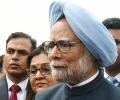
Condolences have poured in from across the globe, including from the United States, Canada and Sri Lanka following the demise of former Prime Minister Manmohan Singh.

A day after premier K P Oli resigned, Nepal President called on all the political parties to elect a new prime minister within a week

President Bidya Devi Bhandari administered the oath of office and secrecy to Oli, 69, at a ceremony at Shital Niwas, after he was reappointed to the post on Thursday night as the Opposition parties failed to secure majority seats in Parliament to form a new government.
The passengers included 10 foreigners, according to the state-run Nepal Television.

Bhattarai said his party 'Naya Shakti Nepal' would bear the "historic responsibility" of making Nepal prosperous and developed.
Security expert B Raman on the emerging situation in Nepal after its PM Prachanda resigned.
The rebels threatened to resume the blockades of highways leading to capital and other district headquarters if Parliament failed to set in motion the process for constituent assembly elections on Friday.
Nepal's President Ram Baran Yadav has directed Army Chief Gen Rukmangad Katawal, sacked by Prime Minister Prachanda, to continue in office in a face-off between the two leaders that threatens to escalate the political crisis and derail the peace process.

In a press statement, the foreign ministry here said 10 Nepali nationals lost their lives in the recent attack by Hamas in Israel.
India has urged caution and consensus-building among Nepal's political parties so that the nation does not get further sucked into political uncertainty due to the events in the past few days, with the latest being the resignation of Prime Minister Pushpa Kamal Dahal (Prachanda) after President Ram Baran Yadav asked Army chief General R Katawal to stay on despite Prachanda's move to replace General Katawal.

60-year-old Khanal, leader of the Communist Party of Nepal (United Marxist-Leninist), secured 368 of the 557 votes cast in the 601-member Parliament, the speaker announced.

Prachanda will hold wide-ranging talks with Prime Minister Manmohan Singh on Monday, particularly reviewing the 1950 bilateral Trade and Transit Treaty, which the Nepalese leader wants to be replaced by a new one.
Koirala told the former rebel that they should wait until the constituent assembly elections expected in June.
India favours a national unity government in Nepal and is ready to renegotiate the 1950 treaty

The proposed China visit of Oli, who took over as prime minister in October, is in marked contrast to the usual practice the new prime ministers of Nepal follow. Most of the Nepalese premiers have visited India, ahead of China.

The new rail and road cargo service launched on Friday, linking Guangdong, Tibet and Nepal, aims to boost trade with the South Asian neighbour as China pushes forward its Belt and Road (Silk Road) initiative, state-run Xinhua news agency reported on Saturday.

The MEA described the mural as an artwork that depicted the spread of the prehistoric Ashokan empire.
After leading his party to a surprise victory in the landmark Nepal polls, Maoist supremo Prachanda is now tackling a busy schedule, unable even to spare time to celebrate his victory or interact with the media. Prachanda had a meeting with Indian Ambassador Shiv Shanker Mukherjee, who went to congratulate him at his residence. The Maoist chairman also met human rights activists and went to Prime Minister Girija Prasad Koirala's Baluwatar residence to thank him.
According to the Constitution, which has 167 articles, all executive powers as well as those enjoyed by the King in the previous Constitution, now vest upon the prime minister.
Nepal's Maoist leaders have suggested a referendum to decide the fate of the monarchy if the country is not declared a republic through parliament. Maoist chairman Prachanda and his deputy Dr Babu Ram Bhattarai, recommended a referendum to Prime Minister Girija Prasad Koirala during their meeting on Sunday.
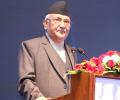
Nepal's political crisis deepened on Friday as both embattled Prime Minister K P Sharma Oli and the Opposition parties staked a claim for the formation of a new government by submitting letters comprising signatures of lawmakers to President Bidya Devi Bhandari.
The Communists would support the Opposition groups ``as much as possible,'' rebel leader Prachanda said in a statement sent to news organisations. It was not clear if he was offering armed support.
The Communist Party of Nepal Maoist, which emerged victorious in the recent Constituent Assembly polls, decided on Wednesday that the next government should be under its leadership and that party chairman Prachanda' would head the government. The meeting reaffirmed the abolition of monarchy and implementation of republic in the country and concluded to form a coalition government and continue consensus with other parties.
"Our past policy towards the 1950 treaty remains unchanged, we want to scrap that treaty and replace it with a new one in the changed context," Maoist chairman Prachanda told as the former rebels were poised to head a new government. "We also want to review all other treaties signed between Nepal and India," the 54-year-old former school teacher said.

'By treating Nepali politicians as shabby buffoons to be pampered one day and collared another day, India badly exposed itself.' 'A belief got entrenched in the Nepalese mind that we are a dangerous neighbour,' observes Ambassador M K Bhadrakumar.
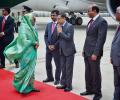
In addition to participating in the swearing-in ceremony, the leaders will attend a banquet hosted by President Droupadi Murmu at Rashtrapati Bhavan, it said.
Maoist chief Prachanda is ready to meet Nepal's King Gyanendra to persuade him to quit the palace as the monarch made it clear that he has no immediate plans to take refuge in India. The Maoist supremo said the King would be allowed to do business or other activities, including politics, if he desired so. The King should not be ousted from the throne in a humiliating manner as it would have negative impact at home and abroad, he said.

External Affairs Minister Salman Khurshid's daylong "goodwill" visit to Nepal on July 9 will give him an opportunity to meet top functionaries of its interim election government as well as the leaders of the main political parties.

Nepal Prime Minister Sushil Koirala on Saturday resigned even as Parliament prepares to elect a new premier tomorrow after parties failed to forge a consensus amid continued protests and blockade of a key border trade point with India over the country's new Constitution.
Nepal's lawmakers on Monday rejected Maoist chief Prachanda and his NC rival Ram Chandra Poudyal for the fifth time in the Prime Ministerial elections, plunging the country into a deeper political crisis in the absence of a government.

The 76-year-old Nepali Congress president, who has served as the prime minister for a record fifth term, defeated his challenger party general secretary Gagan Kumar Thapa by 39 votes, officials said.

Nepal on Friday recalled its ambassador to India over charges of non-cooperation and indulging in anti-government activities.
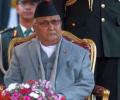
'The redrawing of the map with the inclusion of Kalapani area by Nepal and endorsement from the House of Representatives shows the KP Oli government's move to gain cheap popularity in the name of nationalism'

The 75-year-old veteran politician and Nepali Congress President took the oath of office and secrecy from President Bidya Devi Bhandari during a swearing-in ceremony which was delayed by over two hours.
 © 2026 Rediff.com - Advertise with us - Disclaimer - Privacy Policy - Sitemap - Feedback - About us - Terms of use - Grievances